How Silent and Sound Films Use Performance Differently
Compare silent and sound film performance by tracking how gesture, voice, and timing shape a character’s choices in a single scene.
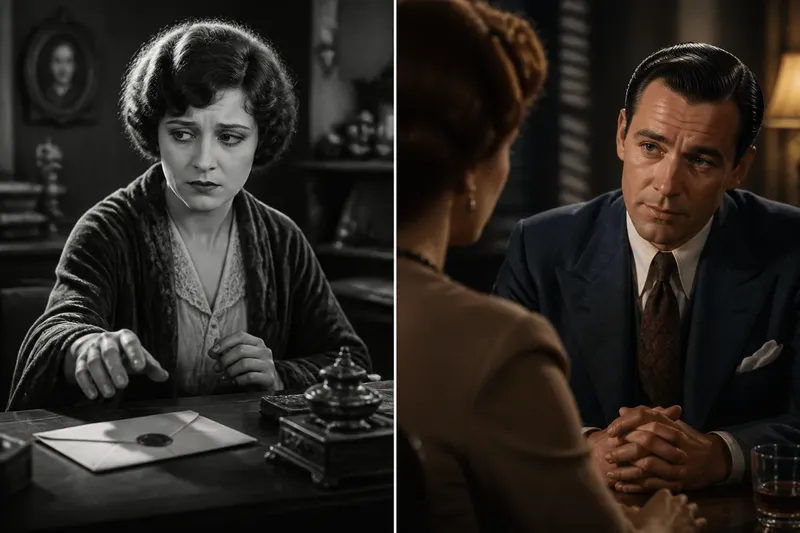
Silent and sound film performance ask actors to make a character’s intention legible through different combinations of gesture, voice, and timing. Compare one scene from each kind of film, and focus on how each performer shapes a moment of decision rather than treating screen acting as a simple progression from broad signs to natural speech.
Compare what each scene asks the actor to communicate
Choose two brief scenes with a similar dramatic task: a character must refuse an invitation, hide a disappointment, or ask another person for help. One can come from a silent film and the other from a sound film. Keep the comparison narrow; differences in plot or genre can otherwise distract from the performers’ choices.
Watch each scene once without pausing. Write down the character’s immediate goal, the obstacle, and the point at which the situation changes. Then note what you can identify through the performance alone and what depends on titles, dialogue, or other information in the scene.
Silent films vary in style, and so do sound films. Avoid assuming that every silent performer uses enlarged gestures or that every sound-era performance favors restraint. Treat each scene as its own arrangement of acting, staging, and storytelling.
Track how silent films organize expressive information
In a silent scene, performers may communicate through gesture, facial expression, costume, and the timing of an action. Intertitles can supply dialogue or context, while the performer’s choices show how a character responds. These elements work together; a lifted hand does not carry one fixed meaning outside its scene.
Look at the moment a gesture begins, how long it lasts, and whether it changes before the next action. Ask whether it clarifies a decision, marks a shift in feeling, or draws attention to something the character wants to conceal. The answer depends on the surrounding events, not on a gesture dictionary.
Also consider the film’s presentation. A gesture that reads clearly in a broad composition may have a different effect in a closer view, and the pace of the scene can shape how long the audience has to register it. Describe what the performer does before deciding whether the choice feels forceful, restrained, or stylized.
Listen for how dialogue changes the performance
In a sound film, words can explain a plan or give a direct answer, but they do not settle what the character feels. Listen for the actor’s phrasing, pauses, breath, and shifts in vocal emphasis, then compare those choices with the timing of the physical action.
A line may agree with the character’s visible behavior, or it may conflict with it. If a character says that everything is fine while delaying an answer, the gap between speech and action can invite an interpretation. Check whether later moments support that reading rather than treating one pause as proof of a hidden emotion.
Sound also changes how an audience receives stillness. A quiet response can carry vocal detail that a silent scene cannot offer, while a silent performer may use a clearly shaped action to mark a change. Neither approach is inherently more expressive; each gives the actor different resources.
Compare the actor’s choices before, during, and after a line
Use a notebook and a pause button to compare three moments in each scene: just before a line or action, during it, and immediately after. Record an observable choice rather than an interpretation first. For instance, write “the actor waits, then looks down” before adding what that timing might suggest.
- Before: Check whether the actor begins an action or holds back; if the action starts early, note how it prepares the moment, and if not, compare the stillness with what follows.
- During: Check whether the actor’s gesture continues, changes, or stops; if it matches the words, record the alignment, and if it conflicts, consider what the mismatch adds.
- After: Check whether the actor responds immediately or delays; if the response is immediate, note the direct reaction, and if delayed, ask what the scene establishes during the pause.
- Across the exchange: Check whether a physical or vocal choice recurs; if it repeats in a changed situation, compare the variation, and if it does not, avoid calling it a character habit.
- At the turning point: Check which observable choice changes when the character’s goal or obstacle shifts; if one choice changes, connect it to that event, and if none does, look for a change elsewhere in the scene.
- Between the films: Check which information comes from performance and which comes from titles or dialogue; if the sources differ, describe the difference, and if they overlap, compare how each performer reinforces it.
Say you choose an invented comparison: in a silent scene, a character reaches toward a sealed letter, stops, and turns away; in a sound scene, another character says, “I knew,” then waits before answering a question. First, record those actions without assigning emotions. Next, note that the silent performer’s interrupted reach makes the letter part of the visible decision, while the sound performer’s delay falls after an explicit statement. The resulting comparison is that one scene makes hesitation legible through an unfinished action and the other through speech timing; neither detail alone establishes exactly what the character feels.
Which details help compare silent and sound performance?
Does silent film acting always rely on large gestures?
No. Silent films use different performance styles, and a scene’s framing, pace, and dramatic situation affect how a gesture reads. Describe the action in its context before judging its scale.
Does dialogue make physical acting less important?
No. A performer’s timing and physical choices can reinforce, complicate, or contradict what the character says. Compare the action with the line rather than treating either as the complete meaning.
How can I compare scenes from different films fairly?
Choose scenes with a similar dramatic task, such as refusing a request or concealing a reaction. Then compare what the actor communicates and which other information the scene supplies through titles, dialogue, or staging.
What should I record before interpreting a performance?
Write down visible actions and audible choices: when a gesture begins, whether a response is delayed, and how a line is phrased. Add an interpretation afterward, and keep it open to revision if other moments point elsewhere.
Make a specific comparison without overclaiming
Build your claim from an action, its timing, and the scene’s dramatic context. For example, you might say that an interrupted reach makes a character’s hesitation visible before any explanation arrives. That statement describes an effect the scene supports without pretending that one gesture has a universal translation.
When comparing silent and sound film performance, look for how each actor distributes information among the body, voice, and timing. The useful distinction is not that one style is more authentic, but that each scene gives the performer different ways to shape what the audience notices.
For a clear comparison of silent and sound film performance, keep your notes tied to specific moments and separate observation from interpretation. A delayed answer, an unfinished action, or a change in vocal emphasis becomes meaningful through its place in the scene, so include that context when you explain what the performance does.